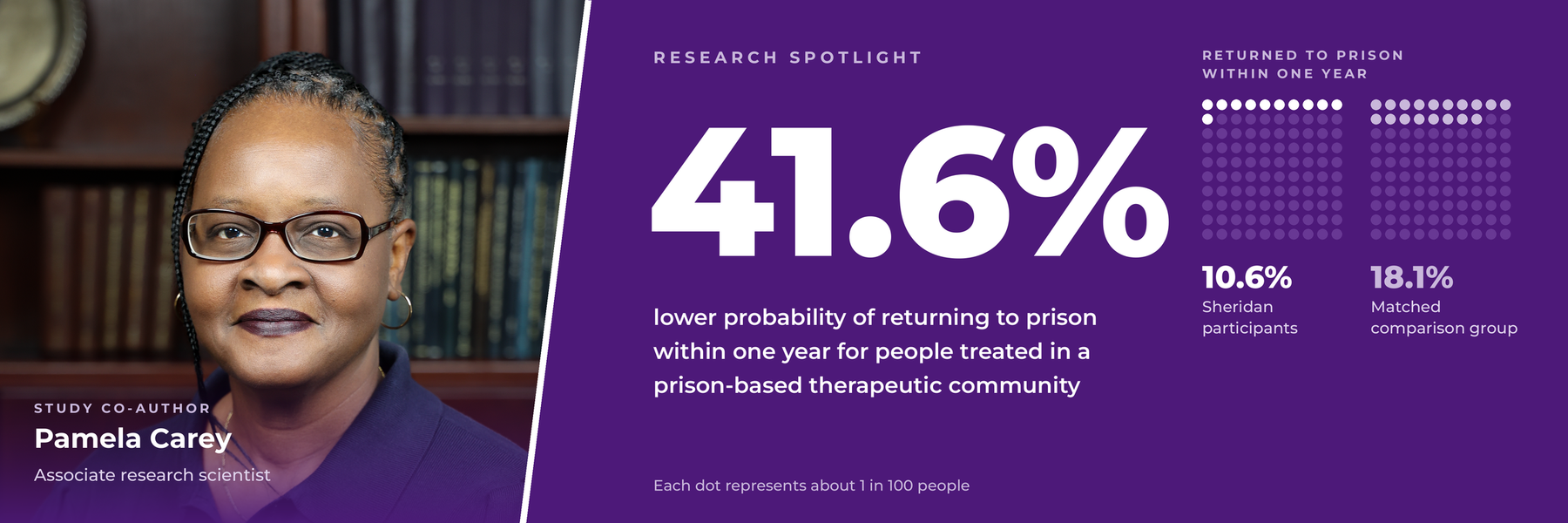
A study co-authored by Pamela Carey, associate research scientist at the Institute of Behavioral Research (IBR) at TCU, found that people who received substance use treatment in prison-based therapeutic communities had lower rates of arrest and reincarceration after release.
Published in the Journal of Experimental Criminology, the study evaluated therapeutic community programs at two Illinois correctional facilities. Therapeutic communities use a structured, residential treatment model in which participants live and take part in treatment together, with an emphasis on personal responsibility, behavior change and preparation for reentry.
Researchers compared people released from the two therapeutic community facilities with statistically similar individuals released from other Illinois prisons. At Sheridan Correctional Center, a medium-security therapeutic community, 10.6% of participants returned to prison within one year compared with 18.1% of the matched comparison group. That represents a 41.6% lower probability of reincarceration.
Three years after release, Sheridan participants continued to show a lower probability of reincarceration, along with reductions in general, violent, drug and domestic violence arrests.
Researchers found similar patterns at Southwestern Illinois Correctional Center, a minimum-security therapeutic community. Participants had lower rates of general arrests and reincarceration at both one and three years after release.
The effects of treatment decreased over time, and the researchers noted that the study’s nonexperimental design limits the conclusions that can be drawn. They called for additional research to better understand which parts of the therapeutic community model contribute to improved outcomes and how those effects can be sustained.
The study grew from work conducted through the Justice Community Opioid Innovation Network (JCOIN) TCU Hub, a multisite research project led through IBR that examines strategies to improve substance use treatment access and outcomes for justice-involved individuals.
Carey co-authored the study with Damon M. Petrich and David E. Olson of Loyola University Chicago. The research was supported by the National Institute on Drug Abuse.
Read “The Impact of Therapeutic Communities on Recidivism in Illinois” in the Journal of Experimental Criminology.